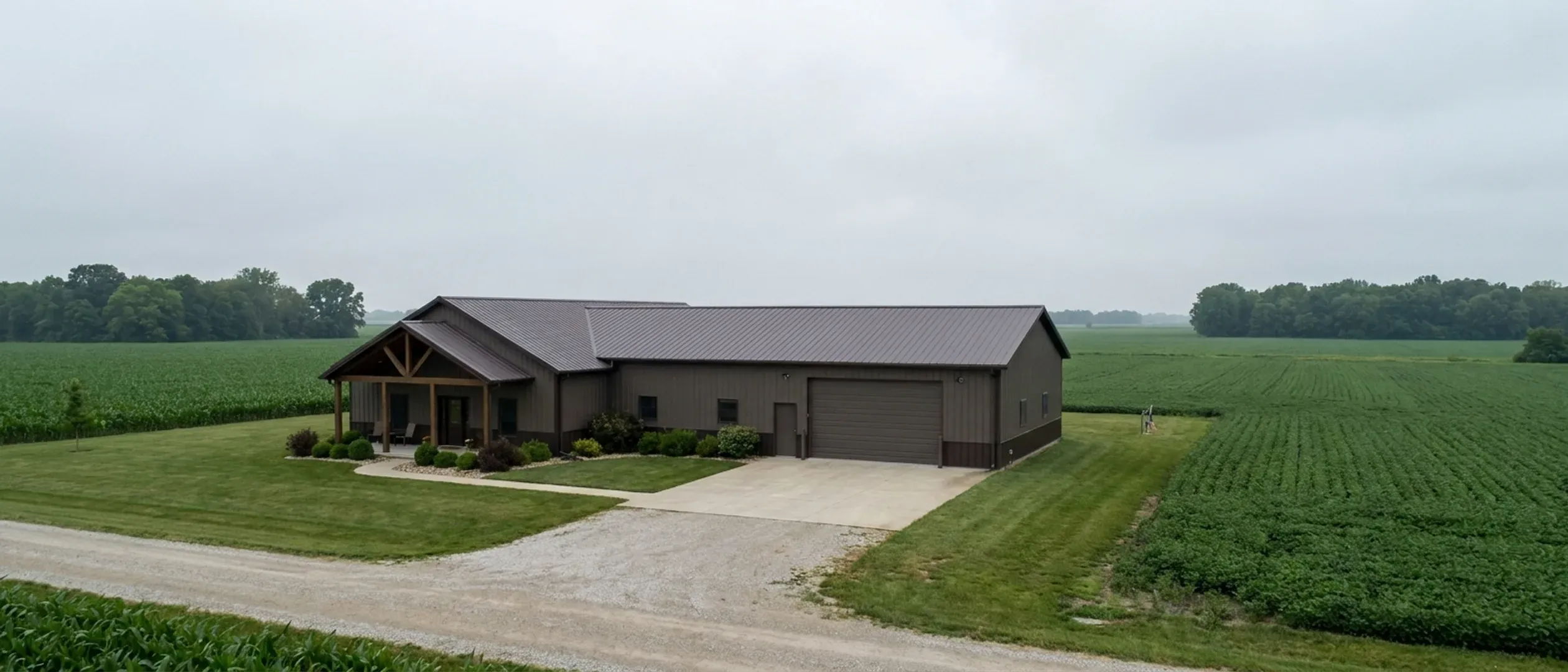
Barndominium Financing in Ohio: Construction Loans, Appraisals and FHA, USDA and VA
Most barndominiums in Ohio are paid for the same way any custom house is: with a construction loan that turns into a mortgage when the building is finished. What makes a barndominium harder is rarely the steel or the post frame. It is the appraisal, because a lender sizes the loan against a value, and an appraiser builds that value from sales of similar houses nearby. On rural Ohio acreage there may be few of those. This guide explains how construction-to-permanent lending works, why comparable sales matter so much, and what the three federal programmes people ask about (FHA, USDA and VA) require, in their own agencies' words. This page names no lenders, quotes no rates and is not financial advice.
Figures on this page are cited third-party or government data, not a quote from Ohio Barndominium Builders.
How a construction-to-permanent loan works
A barndominium is usually built rather than bought, so it is usually financed with a construction loan. The question is whether that loan and the mortgage close once or twice.
One closing or two
A single-close, or construction-to-permanent, loan closes before construction starts, funds the build in stages and then converts into a long-term mortgage without a second closing. HUD's Handbook 4000.1 describes its FHA version in exactly those terms: a construction loan combined with a permanent residential mortgage using a single closing before construction begins. A two-close arrangement uses a short-term construction loan first and then a separate mortgage to pay it off at the end, which means qualifying and paying closing costs twice and taking whatever terms are available at the second closing.
Money moves in draws, not in one payment
After any land purchase is paid at closing, construction money sits in an escrow or loan account and is released as the work progresses. HUD's handbook, for example, requires the lender to get the borrower's written authorisation before each draw is paid to the contractor. Ask for the draw schedule in writing. A barndominium shell can go up quickly while the interior takes longer, so a draw schedule written for a conventional framed house can leave money and progress out of step in the middle of the job.
The loan is sized against the lesser of two numbers
For FHA construction-to-permanent loans, HUD's handbook tells the lender to use the lesser of the appraised value and the documented acquisition cost, which includes the builder's price and, depending on how long you have owned it, the cost or appraised value of the land. Conventional lenders reason the same way even where the arithmetic differs. The practical effect is that neither a low build price nor a high appraisal helps on its own: the smaller of the two sets the loan.
Land you already own can count toward your stake
Under the FHA construction-to-permanent rules, a borrower may use land equity toward the minimum required investment. Land owned for more than six months at case number assignment is counted at its appraised value. Other programmes and lenders treat land equity in their own ways, so ask how yours will count it, and bring the deed and any payoff statement for the land to the first meeting.
The appraisal-comps problem
The hardest part of financing a barndominium is proving what it is worth to someone who was not there when it was built.
An appraisal is an argument from comparable sales
An appraiser values a house mainly by finding recent sales of similar properties nearby and adjusting for the differences. A steel-frame or post-frame house on ten acres in a rural Ohio township may have very few genuine comparables within a reasonable distance and time window. When the appraiser has to search further or adjust more, the result is less certain, and if it comes in under the contract price the gap is yours to cover. That is a data problem, not a judgement on the building.
The shop is a valuation question as well as a design one
A shop-house is two uses under one roof, and an appraiser treats finished living area differently from shop or garage space. A plan that is mostly shop with a small apartment will be valued differently from one that is mostly house with an attached workshop. If the loan matters to you, settle the living-to-shop split with the appraisal in mind, not only with the workshop in mind.
Ask before you are under contract
Before a design is fixed, ask a lender who has closed post-frame or steel dwellings in your county, or a local appraiser, whether comparables exist. One conversation usually tells you whether the valuation will be straightforward or a stretch. Where comparables are thin, a larger down payment, a more conventional exterior or a higher proportion of finished living space can each narrow the gap.
Documentation helps the appraiser and the underwriter
A complete file makes the building easier to value: the plan set, the written contract, the foundation design, insulation and energy details, the health district's septic and well permits, and the building department's approvals and inspection records where a certified department covers the land. Where none does, records from independent inspections at footing, framing and final stages go some way to filling the gap.
FHA, USDA and VA: what each programme actually requires
These are federal programmes, not products of any builder. Their eligibility rules come from the agencies, and approval comes from an approved lender. The summaries below paraphrase each agency's own published material as read in September 2026; confirm the current rules on the agency pages before relying on them.
FHA: construction-to-permanent under HUD Handbook 4000.1
The Federal Housing Administration insures mortgages made by FHA-approved lenders. HUD's Single Family Housing Policy Handbook 4000.1 sets out a construction-to-permanent programme for building on land the borrower owns or is buying. The borrower must have contracted with a builder, and the handbook requires that builder to be a licensed general contractor; the borrower may act as general contractor only if the borrower is one. The interest rate may float during construction within an agreed range, and the lender must qualify the borrower at the maximum rate the permanent loan could carry. The borrower must make a minimum required investment of at least 3.5 percent of the adjusted value, and at least one borrower must occupy the home as a principal residence within 60 days of signing and intend to stay at least a year.
FHA: mortgage insurance starts after the final inspection
The same handbook requires the borrower to be told that the loan is not eligible for FHA mortgage insurance until after a final inspection, or a certificate of occupancy from the local jurisdiction, whichever is later, and the loan must be endorsed within 60 days of that point. On Ohio land with no certified residential building department, no certificate of occupancy is issued under the Residential Code of Ohio. Ask the lender at the start how it will complete this step for your parcel.
VA: eligibility starts with a Certificate of Eligibility
The Department of Veterans Affairs backs home loans that lenders make to eligible service members and veterans. VA's own page says a VA-backed purchase loan can help you buy, build or improve a home. To be eligible you must qualify for a Certificate of Eligibility, which VA grants on minimum service requirements that depend on when and how you served (for example, 90 days of active duty in some periods, 181 days in others, or 6 creditable years in the National Guard or Selected Reserve). You must also meet VA's and the lender's credit and income standards, and you must live in the home. VA notes that no down payment is required as long as the price is not higher than the appraised value, which brings the appraisal back to the centre of the question.
USDA: the Section 502 guaranteed loan for eligible rural areas
USDA Rural Development's Single Family Housing Guaranteed Loan Program backs loans that approved lenders make to low- and moderate-income households buying, building, rehabilitating or improving a home in an eligible rural area. Rural Development's page sets three applicant tests: household income no higher than 115% of the area median, personal occupancy as a primary residence, and U.S. citizenship, non-citizen national or qualified alien status. The property must lie in an area USDA treats as eligible, which you can check address by address on USDA's eligibility site. The programme describes the homes it finances as modest, decent, safe and sanitary, so ask the lender how a large shop fits that description before designing around it.
USDA also runs a direct programme
Alongside the guaranteed loan, Rural Development runs Single Family Housing Direct Home Loans, for which individuals apply to Rural Development itself rather than through a private lender. The eligibility rules differ from the guaranteed programme and are set out on Rural Development's page and through its Ohio state office.
Conventional loans and local lenders
Many barndominiums are financed conventionally rather than through a federal programme, often by local banks, credit unions and farm credit lenders that keep construction loans on their own books and know rural property. Their down payment, reserve and appraisal requirements are their own, so compare terms in writing. This site does not recommend or endorse any lender.
What to prepare before you apply
A construction lender is lending against a building that does not exist yet. The more of it you can show on paper, the easier the conversation.
A complete plan set and a written contract
Bring the floor plan, elevations, foundation details and specifications, plus the signed builder's contract. Ohio does not require an architect's or engineer's seal on plans for a one-, two- or three-family dwelling under ORC 3791.04(A)(2)(b), but the lender and appraiser still need drawings they can read.
The land file
Bring the deed or purchase contract, the survey if you have one, any payoff statement for the land, and evidence of access. If you are buying the land with the loan, the lender will want the purchase figures and date on the closing documents.
The approvals map for your parcel
Know which offices have a say: the township, county or city zoning authority; the building department certified for residential work, if one covers the land; the health district for septic and well; and the road authority for the driveway. A lender that sees this mapped out has fewer reasons to hesitate.
A cover quote for the finished building
Lenders require property cover on the finished home, and HUD's handbook lists evidence of hazard cover among the documents for an FHA loan. Some carriers ask more questions about steel or post-frame dwellings and attached shops, so get a quote on the actual design before closing rather than after.
Reading this because you are weighing a build? The next step is a plan drawn for your program.
What's different about Ohio
The builder's contract is part of the lender's file
A construction lender funds a construction-to-permanent loan against a specific build, so it will want the signed builder's contract along with the plans and specifications. The contract, the budget and the draw schedule have to agree with one another, and gaps between them are easier to fix before closing than after.
Changes during construction have to be funded
A construction loan is funded to a budget. A change the lender did not approve has to be paid from somewhere, so agree how changes and unforeseen extra costs will be priced and approved before the first draw, and keep the lender informed when one comes up.
No certified building department can mean no certificate of occupancy
Ohio has one statewide residential code, the Residential Code of Ohio, but under ORC 3791.04 and RCO §101.5 it is enforced only where a building department certified by the Board of Building Standards for residential work covers the land. Where none does, the owner is not required to submit plans, request inspections or obtain a certificate of occupancy. Federal loan programmes and many lenders expect a final inspection or certificate of occupancy at completion. If your parcel sits outside a certified department's area, ask your lender early what it will accept instead, and consider paying for independent inspections at the stages a department would have checked.
Ohio does not issue a general contractor licence
Ohio has no statewide general-contractor or home-builder licence. The Ohio Construction Industry Licensing Board licenses five specialty trades for commercial work, and residential contractors are regulated locally, city by city. This matters for FHA construction-to-permanent lending in particular, because HUD's handbook requires the builder to be a licensed general contractor. How a lender documents that for a parcel in an Ohio township with no local licensing is a question for the lender, and it is better asked before you choose a loan programme.
The septic and well permits come first
Wherever you build in Ohio, the local health district permits the septic system and the private well, whether or not a certified building department covers the land. Septic systems are sized by bedroom count under OAC 3701-29-11, and a site review with a soil evaluation comes before the installation permit. A lender financing construction on raw land will usually want to know that the land can take a system for the house you are drawing. Getting that answer early protects both the budget and the appraisal.
Pros and cons, honestly
Pros
- A single-close construction-to-permanent loan means one qualification and one set of closing costs for the build and the mortgage.
- Land you already own can count toward your stake under FHA's construction-to-permanent rules, and many lenders give it similar weight.
- VA-backed and USDA guaranteed loans can finance building a home, with no down payment for those who qualify.
- A complete plan set and a statutory written contract answer most of what a construction underwriter asks.
Cons
- Appraisals are harder where there are few comparable post-frame or steel dwellings nearby, and a low appraisal is your gap to fill.
- Shop space and living space are valued differently, so a shop-heavy plan can appraise below its cost.
- FHA's construction-to-permanent rules require a licensed general contractor, and Ohio issues no statewide general contractor licence.
- On land with no certified residential building department there is no certificate of occupancy, which federal programmes and many lenders expect.
- USDA's guaranteed loan has income limits and rural-area limits, and it describes the homes it finances as modest.
- Draw schedules written for conventional houses can leave money and progress out of step on a barndominium.
Is this financial advice?
Can you get a 30-year mortgage on a barndominium in Ohio?
Why do some banks not like barndominiums?
Can I use an FHA loan to build a barndominium?
Can I use a VA loan to build?
Does USDA finance barndominiums in rural Ohio?
What should I bring to a first meeting with a lender?
Questions answered? Tell us what you want to build and we will put real numbers against it.
Keep reading
The pages that answer the next question this one raises.
What a barndominium costs to build in Ohio
Sourced third-party cost figures and the Ohio site costs that move the total.
Read itAre barndominiums allowed in Ohio?
Who enforces the Residential Code of Ohio, how zoning works, and what the health district permits.
Read itAre barndominiums worth it?
The shop-plus-living economics, resale and who a barndominium suits.
Read itTurnkey builds
One written contract covering the site, the shell and the finished interior.
Read itWant a real number instead of a range?
Start your plans and we will come back with a budget for what you actually want to build, not a national average. Send the parcel ID or an address when you have one and we will price it against your land. That conversation costs nothing.